











.svg)







.png)


On-call responsibilities have become one of the most invisible stressors in modern organizations, especially in teams where uptime and rapid response are tied directly to customer trust. Many companies compensate people for the inconvenience of being available, yet far fewer understand the psychological, logistical, and fairness-based components of doing it properly.
This is more than a payroll decision; it influences professional dignity, mental load, and the sustainability of operational excellence. When on-call is managed fairly, workers feel trust in leadership; when mishandled, it quietly creates resentment and attrition.
Key Takeaways
- On-call pay must account for restricted personal time, recognizing that availability alone carries psychological cost.
- Transparent compensation policies reduce resentment and confusion, giving employees clarity and trust in leadership.
- Fair rotation systems prevent burnout, ensuring that the burden of readiness isn’t concentrated on a small subset of the team.
- Tracking incident frequency enables data-driven staffing decisions, revealing system weaknesses and workload imbalance.
- HR-aligned on-call structures protect compliance and morale, ensuring readiness is treated as real labor rather than unpaid obligation.
What Is On-Call Pay? A Modern Definition
Being “on-call” means someone isn’t actively working, but they must be reachable and ready to respond when an issue arises. Even if they’re not actively handling tasks, their personal time is partially restricted, and their attention and flexibility are limited by the possibility of interruption. This subtle constraint is what makes on-call different from true off-hours rest.
On-call differs from standard work schedules because regular hourly or salaried roles end at a predictable time, while on-call creates uncertainty and delayed mental relaxation. Even salaried professionals may experience fairness concerns if after-hours work becomes routine without appropriate compensation.
Common terms can create confusion, so it’s important to distinguish:
- Standby: passive availability
- After-hours support: defined time windows after normal shifts
- Pager duty: high-urgency, reactive model
- Restricted time: cannot freely engage in personal activities
- Unrestricted time: personal freedom is intact
If someone must stay near their laptop, maintain connectivity, or remain within rapid-response range, they’re not truly “off-duty”, and that’s when on-call compensation becomes necessary and justified.
Common On-Call Compensation Models
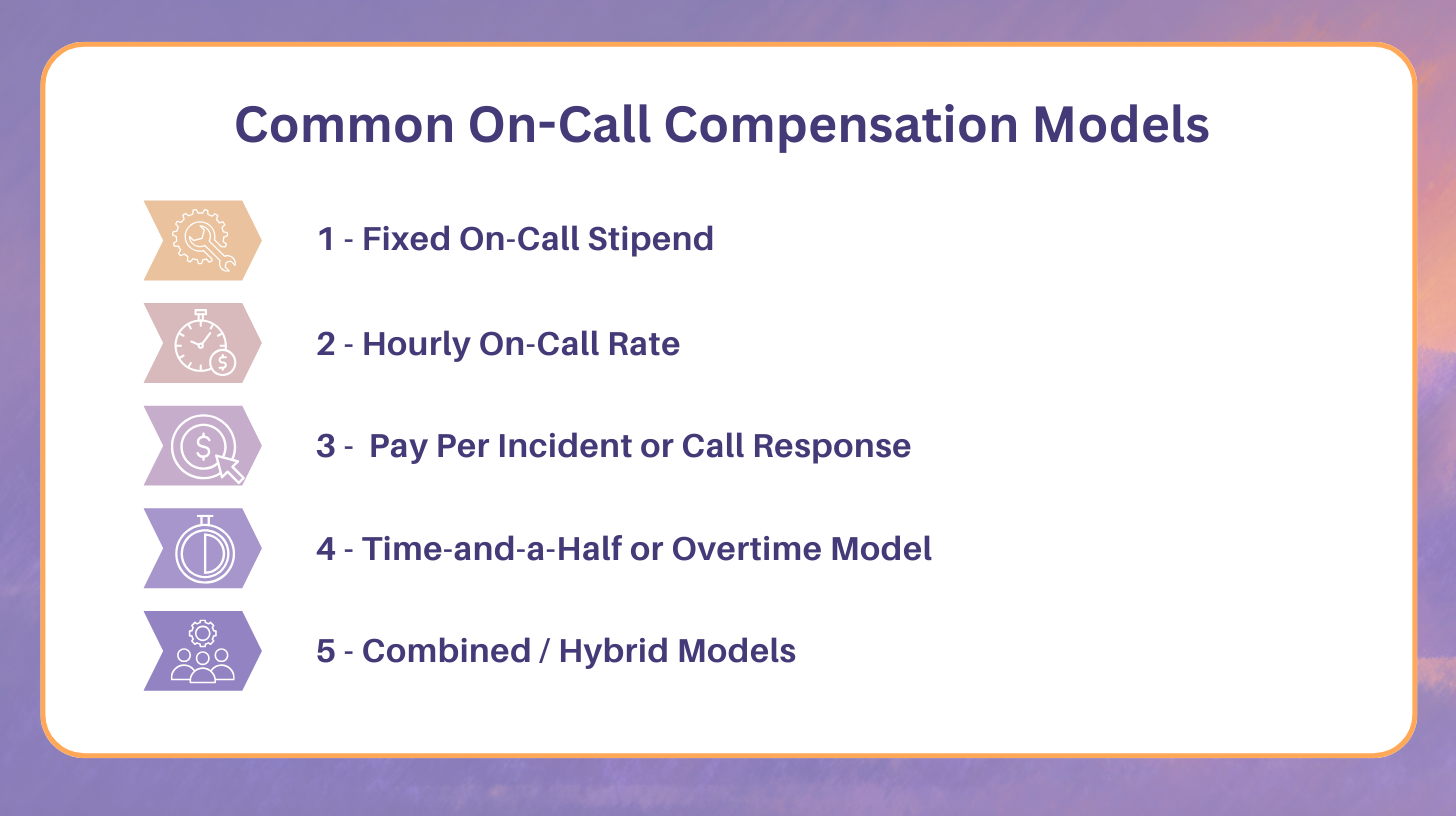
Fixed On-Call Stipend
Many companies pay a flat amount for being on-call, such as $100–$300 for a weekend or $500–$1,200 per month depending on frequency and intensity. This model works when interruptions are infrequent and the burden is primarily psychological rather than active. It also simplifies payroll handling and offers predictable cost to employers.
The fixed model makes sense when teams face fewer than a handful of incidents weekly, and when disturbance levels are moderate. However, it becomes problematic when the frequency of interruptions ramps up, because the stipend doesn’t scale with stress or effort, and workers immediately feel the imbalance.
Hourly On-Call Rate
Some organizations pay an hourly standby rate, such as 1.25x or 1.5x regular wage, even if no incidents occur. This approach acknowledges that readiness itself has value, not just action taken. It adjusts compensation more directly to time committed.
Hourly models are preferable when teams consistently experience mid-level incident volumes. For non-exempt employees under U.S. law, hourly classification may be required to ensure proper wage tracking. Salaried employees benefit from hourly standby only when it’s transparently documented and equitably applied.
Pay Per Incident or Call Response
This model works especially well in IT, cybersecurity, and SaaS operational support. Workers are compensated only when they actively respond, often at a rate higher than typical labor. It incentivizes quick and focused engagement without compensating idle standby.
An “incident” must be clearly defined. Is it a P1? Is it anything requiring investigation? Are false alarms included? Organizations also need to guard against over-signaling or misusing incidents as an “attention lever,” or workers may feel penalized by poor internal alert hygiene. Systems must prevent alert-spam: otherwise, the burden grows silently.
Time-and-a-Half or Overtime Model
When responding to an issue extends into actual working time, the expectation may shift into time-and-a-half compensation, especially in compliance with FLSA. This protects workers from being unintentionally exploited through untracked after-hours workloads. Overtime models force organizations to measure the real cost of operational fragility.
One risk is cost escalation when systems are unstable or under-monitored, but that’s actually a valuable signal; if on-call costs are soaring, the tech debt is speaking through payroll. When disruption frequency is higher than what on-call budgets justify, structural fixes should precede expectations of constant heroism.
Combined / Hybrid Models
Some teams find balance through hybrid approaches, such as:
- Stipend + hourly incident response
- Stipend + per-incident payout
- Standby hourly + overtime after engagement
Hybrids allow organizations to tailor compensation to real world dynamics. They benefit teams with variable incident rates or unpredictable workloads. This approach is increasingly common in modern high-reliability environments where fairness and predictability matter.
Fairness in On-Call Pay: What Employees Consider “Equitable”
Perceived fairness and effort
People don’t judge compensation only by currency; they evaluate emotional cost and lifestyle erosion. Even if emergencies are rare, simply “waiting for the phone to ring” creates invisible tension. Nighttime and weekend interruptions fracture recovery time in ways most orgs underestimate. Teams need shared language around this, not just shared duty.
Distribution fairness
Someone who is constantly on-call will eventually grow resentful, especially when others escape the burden. Rotational practices distribute burden evenly, while skill-based coverage acknowledges specialization, but must avoid over-burdening experts. The best teams monitor distribution imbalance and correct for it proactively.
Compensation transparency
Workers feel far more at ease when the policy is explicit, rather than ambiguous. Clear language prevents resentment and removes negotiation dynamics from incident-time. Many companies underestimate the morale benefit of writing the policy in plain, unambiguous English, not hidden between compliance clauses.
Modern Scheduling Best Practices for On-Call Teams
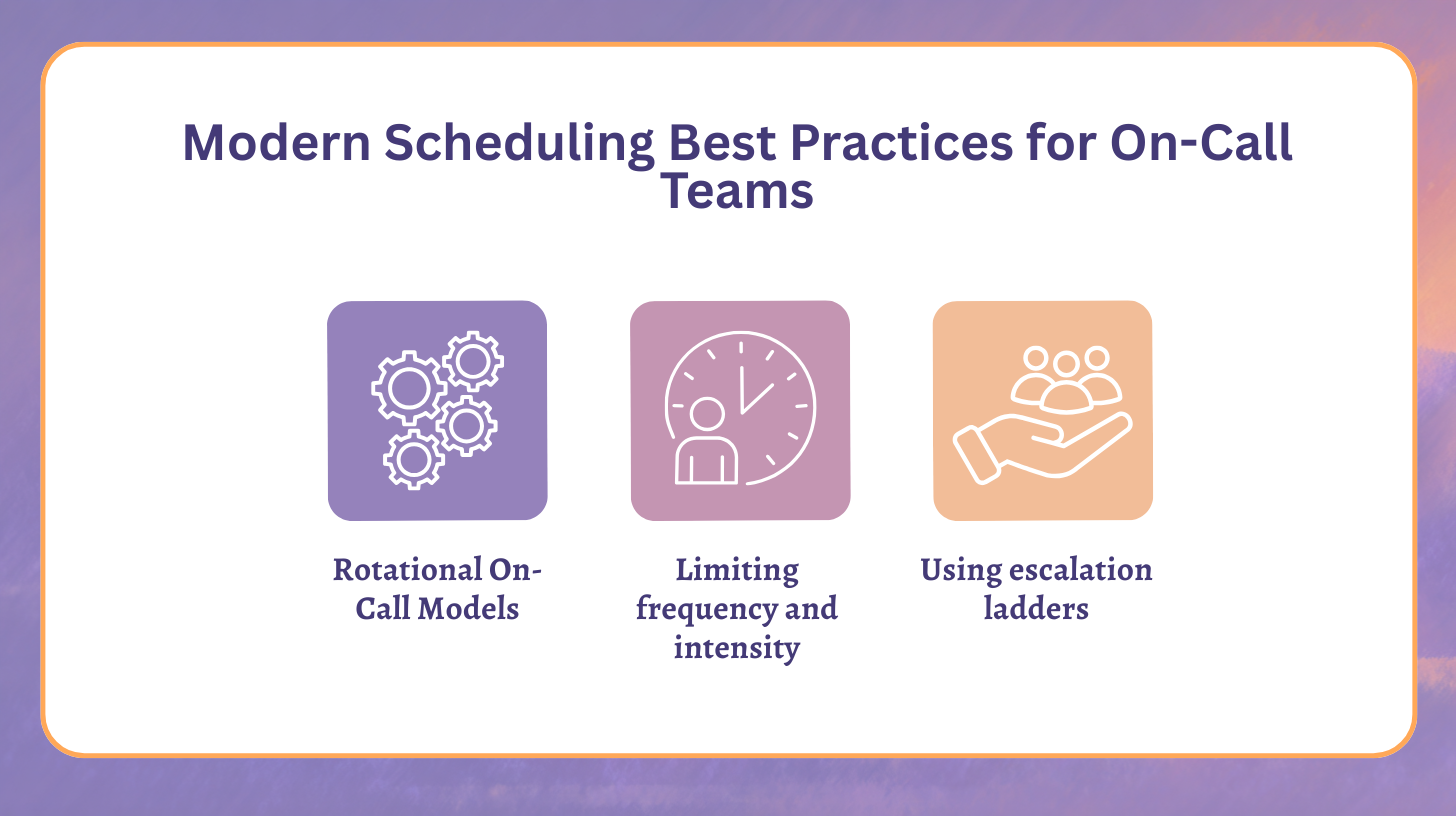
Rotational On-Call Models
A weekly rotation provides continuity while preventing fatigue buildup. Daily rotation works for high-frequency environments but may require tight handoff protocols. Follow-the-sun models allow distributed teams to cover hours without requiring individuals to sacrifice nights or weekends.
Limiting frequency and intensity
Max shift durations prevent chronic fatigue and cognitive erosion, especially in engineering and healthcare roles. Required rest time after high-intensity incidents is essential to maintain sharp reasoning. When organizations set incident caps, they acknowledge human limits rather than assuming infinite elasticity.
Using escalation ladders
Primary responders handle first contact. Secondary responders provide backup and contextual guidance. Specialist escalation is critical when deep domain expertise is required, ensuring the burden of incident resolution doesn’t always fall on the same “go-to” individual.
On-Call Overtime, Legal Requirements & Compliance
On-call and the Fair Labor Standards Act (US)
Under FLSA, on-call time is compensable when restrictions prevent normal personal activity. If a worker must remain near home or refrain from alcohol, it often counts as restricted time. The distinction between passive availability and constrained life-pause is legally important.
International labor law considerations
In the EU, Working Time Directive defines minimum rest periods and caps total working hours. Many Commonwealth countries, including Canada and Australia, have more worker-friendly interpretations of compensability than the U.S. Cross-border companies must avoid applying a single blanket policy across jurisdictions.
Preventing wage-and-hour violations
Misclassifying salaried employees who respond frequently after hours can become a legal liability. Employers need reliable logging systems to track response duration and intensity. Documented, auditable history isn’t merely helpful, it’s legal protection.
HR Policy Alignment for On-Call Work
Writing an official on-call policy
Policies should define expectations clearly: availability windows, compensation rules, and escalation flows. The scope must identify which roles are eligible, and responsibilities must be spelled out concretely. Policy wording should anticipate edge cases to avoid ambiguity.
Collaborating with HR and Legal
HR ensures fairness and retention, while Legal safeguards compliance and defensibility. In unionized or worker-council environments, bargaining agreements may require consultation before changes. Leadership earns respect when policy evolves through collaboration rather than imposition.
Setting expectations during hiring and onboarding
On-call obligations should never be discovered after joining, they belong openly in job descriptions. Candidates often evaluate roles based on how their personal life rhythms align with on-call duties. Transparency during hiring avoids downstream resentment.
Recommended On-Call Policy Structure (for HR and Team Documentation)
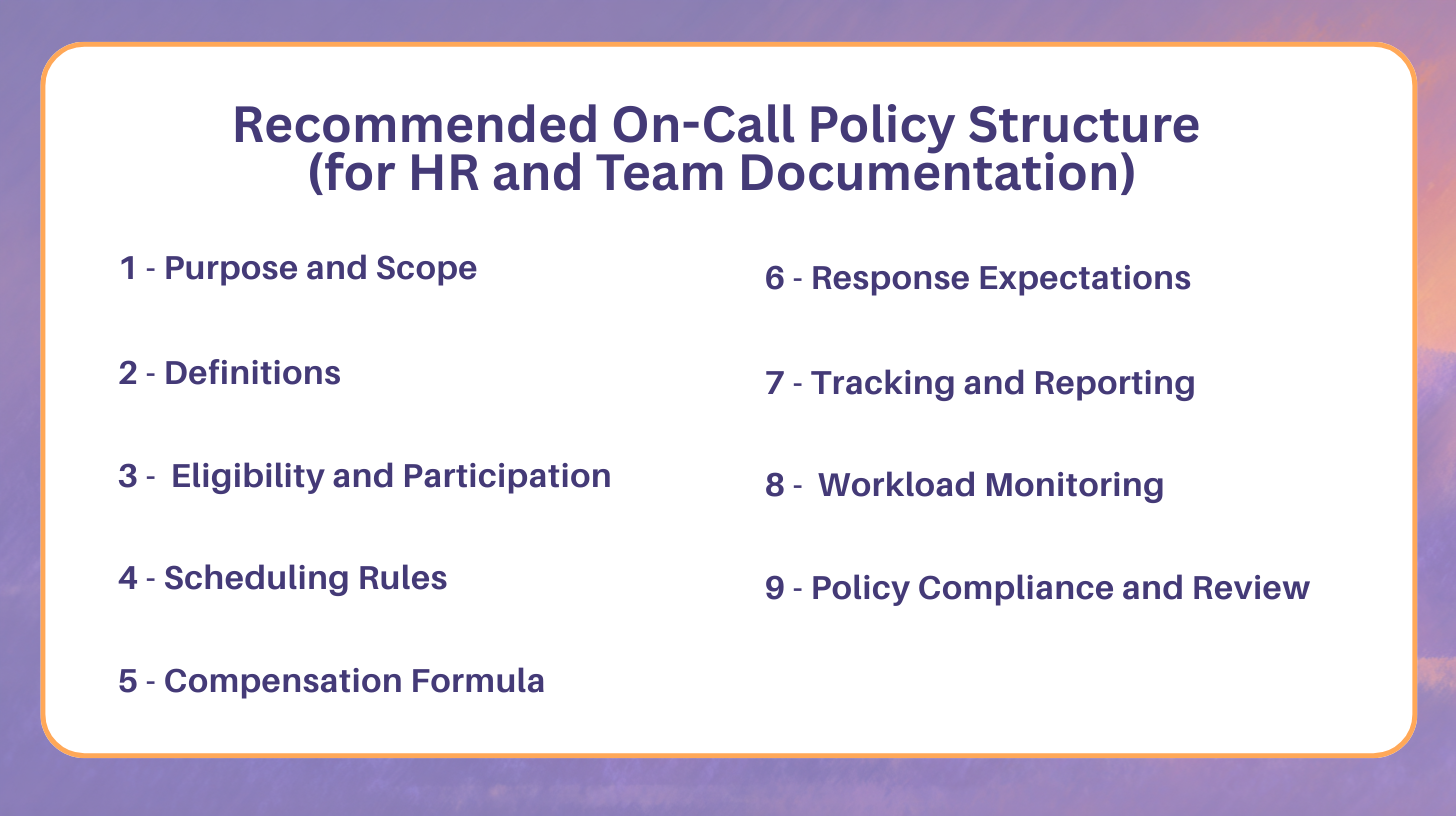
Purpose and Scope
Clear definitions of which roles are included and why prevent confusion or assumptions about responsibility. The policy should also define coverage boundaries, so tasks don’t spill into unrelated domains. This ensures ownership is intentional rather than accidental, which protects both teams and individuals. A well-defined scope sets expectations before stress enters the equation.
Definitions
Policies must tightly define terms like “emergency,” “P1,” “high-severity,” and “critical incident.” No one should be contacted at 3am for something that can wait until morning. Clear thresholds protect personal rest and create mutual trust. When language is explicit, expectations become predictable and humane.
Eligibility and Participation
On-call should not be assigned to someone lacking necessary technical competence or context. Proper training and access to documentation should always precede on-call responsibility. Eligibility must be based on experience, not just availability. This protects both service reliability and individual confidence.
Scheduling Rules
Rotation systems should distribute workload evenly, ensuring no single person carries disproportionate weight. Time-off protections must prevent people from being pulled back into duty immediately after leave. These safeguards preserve rest and recovery, which are essential for high-stakes decision-making. Healthy scheduling practices reduce burnout and resentment.
Compensation Formula
The pay structure must be explicit, documented, and easy to understand. Workers should never need to guess or negotiate compensation on a case-by-case basis. Real-world examples and calculation breakdowns support transparency. When pay clarity exists, trust naturally follows.
Response Expectations
Policies must define expected response times (e.g., 5, 10, or 30 minutes depending on severity level). Escalation paths should be clearly mapped, so responsibility never defaults unfairly to the same person. Communication channels (Slack, phone, pager, SMS) should be standardized and explicit. Clarity eliminates improvisation during stressful moments.
Tracking and Reporting
Incident logging must be accurate for legal compliance, historical insight, and trend analysis. Time-tracking prevents disputes and ensures workers are properly credited. Good documentation creates accountability rather than suspicion. Data becomes a shared source of truth, not a surveillance tool.
Workload Monitoring
If certain individuals consistently receive more alerts or escalations, that imbalance must be recognized and corrected. Higher load is rarely a coincidence; it can signal systemic fragility or skill concentration. Organizations should proactively redistribute work before burnout arrives. Monitoring isn’t just about performance; it’s about care.
Policy Compliance and Review
Policies should be living documents, not static artifacts. Scheduled review cycles maintain relevance as systems evolve. Feedback loops allow workers to surface pain points and suggest improvements. Ownership of updates ensures accountability rather than administrative drift.
On-Call Load Monitoring and Data-Driven Improvements
Tracking incident frequency helps reveal not only system stability but also points of recurring fragility. When interruptions are quantified, teams can spot unfair burden and fix imbalance before it becomes resentment.
- Monitor incident volume per person
- Track time of day alerts occur
- Identify recurring triggers and hotspots
Measuring sentiment through simple surveys and engagement metrics captures the emotional impact of being on-call. People may not speak up verbally, but written feedback often reveals real stress and fatigue.
Reducing noise through smarter prioritization and automation protects responders from alert fatigue. Not every ping deserves attention, and false alarms quietly erode trust in the system. Filtering signals intelligently creates healthier, more humane on-call conditions.
How To Communicate On-Call Expectations to Employees
Clarity prevents confusion and resentment, so expectations must be explicit. Clearly define what counts as a true emergency, set realistic response timelines, and make compensation details transparent. People shouldn’t have to interpret vague wording or guess what’s expected.
- Identify emergency vs non-emergency scenarios
- Outline expected response time (e.g., 5–10–30 minutes)
- Share compensation structure clearly
- Document escalation pathways
- Define who owns follow-up after incidents
This ensures people know their role, the level of urgency, and the exact support chain, reducing stress and creating psychological safety.
Building a Fair and Sustainable Approach to On-Call Pay
The way an organization compensates on-call duty is ultimately a reflection of how deeply it respects the people who protect its uptime, safety, and reliability. Technical excellence is strongest when it’s paired with empathy, and meaningful compensation ensures that emergency readiness is not taken for granted, but honored as real labor and emotional cost. When on-call pay is equitable, transparent, and humane, teams enter incidents with energy instead of resentment, and they carry pride rather than exhaustion.
At Rootly, we will always advocate for on-call practices that uplift people rather than drain them, because operational reliability is only truly sustainable when built on respect for the humans behind the response.