











.svg)







.png)


On-call is often discussed as a responsibility, but not enough as a lived experience. The feeling of having your attention partially tethered to a system at all times is something only those who have carried the pager truly understand. Improving on-call is not only about smoother operations and faster incident recovery.
It is fundamentally about how humans experience readiness, uncertainty, technical responsibility, and the psychological tension of being interruptible. The best managers do not merely optimize processes. They redesign the emotional and structural environment around on-call so that people feel safe, valued, and supported.
Key Takeaways
- Fair on-call scheduling allows engineers to confidently plan their personal time and reduces anxiety around interruptions.
- Clear role ownership ensures each on-call engineer understands their domain, which reduces hesitation and stress during incidents.
- Leadership’s attitude toward accountability shapes team culture, signaling whether on-call is collaborative learning or blame-based pressure.
- Meaningful metrics for on-call track human impact as much as technical outcomes, creating healthier long-term operational habits.
- Compensating on-call as real labor acknowledges its emotional and cognitive cost, strengthening morale and long-term retention.
Defining What “Good On-Call” Actually Looks Like
A healthy on-call environment has certain signature characteristics that your team can feel, not just measure.
- Predictable, transparent schedules: Engineers can plan their lives confidently because the schedule is published early and trades are manageable.
- Proper workload distribution: Fairness is measured not by equal time but by equal incident load and cognitive burden.
- Clear ownership boundaries: Each engineer knows their domain and responsibility scope, eliminating uncertainty and reducing emotional stress.
- Well-documented runbooks and procedures: A strong runbook ensures that engineers never feel alone or unprepared, even at 2 AM.
- Reliable, observable metrics tied to outcomes: Metrics track the human impact of on-call, not just technical uptime, enabling targeted improvements.
- Psychological safety during incidents: Engineers feel secure admitting uncertainty and asking for help, which accelerates resolution and learning.
Leadership Responsibilities in On-Call Culture
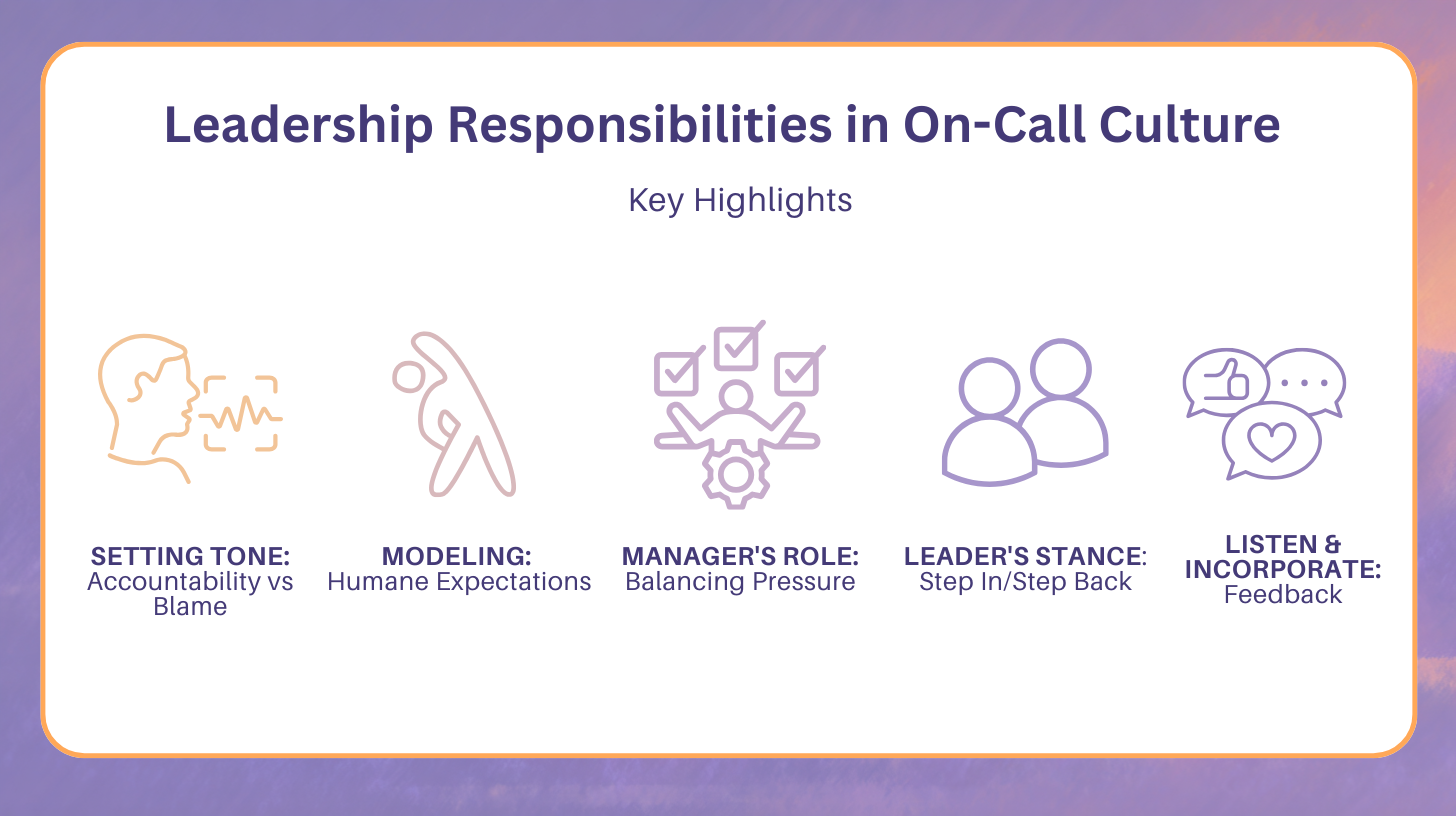
On-call culture is formed by leadership behavior more than by documentation.
Setting tone: accountability vs blame
Accountability is about shared responsibility and growth, while blame isolates and discourages participation. Teams that thrive during on-call see incidents as systemic challenges rather than personal failures. Leaders reinforce that complex systems break due to multifactor complexity, not individual inadequacy.
Modeling humane expectations from the top
If leaders silently expect heroic endurance and round-the-clock stamina, the team will internalize it. When leaders openly support sleep recovery, healthy boundaries, and reasonable workload expectations, it signals that personal wellbeing is not secondary to system performance. This creates psychological permission for others to care for themselves.
Manager’s role in balancing performance pressure
High expectations can coexist with empathy. Engineers should feel trusted to solve problems without needing to be superhuman. Instead of defaulting to “What happened?”, ask “What can we learn and improve?”
When leaders should step in and when they should step back
Leader involvement can either support or disrupt incident response. Effective leaders know when a situation requires direct assistance or when stepping aside allows the engineer to maintain momentum and confidence. Unnecessary intervention generates confusion rather than clarity.
Listening to on-call feedback and incorporating it into policy
Feedback matters only if it leads to visible action. When engineers share pain points and those insights shape policy, trust grows. Nothing diminishes engagement faster than feedback loops that evaporate without response.
The Metrics That Matter: Using Data to Improve On-Call
Understanding on-call performance vs personal performance
Incident response speed reflects system maturity and documentation quality, not just individual capability. If a single engineer consistently absorbs a higher cognitive load because they “just know more,” the problem lies in knowledge distribution, not personal heroism.
Indicators of unhealthy on-call
- frequent escalation
- slow response times
- staff dread
- burnout indicators
These are not merely operational red flags but human ones. Staff dread can be emotionally detectable long before abandonment or attrition.
Incident response KPIs (MTTD, MTTA, MTTR, MTBF, MTTC)
Metrics matter only when connected to actionable improvement. Faster MTTR is not true progress if achieved through exhaustion, stress, and sleep deprivation. Sustainable performance values consistency over urgency.
Measuring alert noise, fatigue, and signal quality
Healthy on-call environments prioritize alert relevance. If engineers become desensitized because half the alerts are non-actionable, real incidents will eventually slip through. Carefully tuned alert policies show respect for human attention.
Tracking incident ownership fairness
Responsibility should not magnetize toward the same person every time. Repeatedly relying on one person’s expertise is not efficiency; it is operational fragility. Distributing knowledge creates structural resilience.
Building a Fair On-Call Rotation
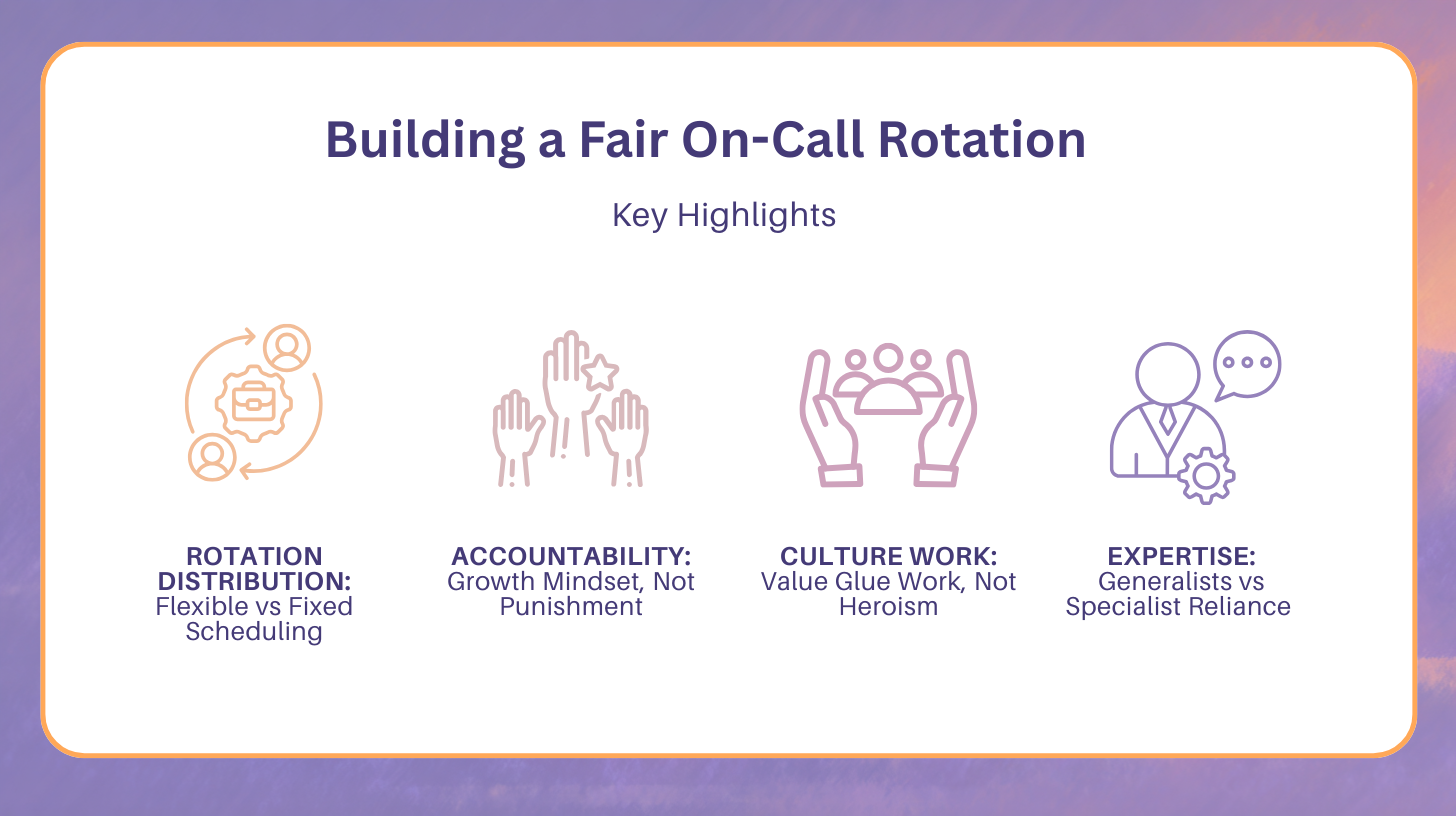
Methods of distribution: fixed, flexible, opt-in, seniority-balanced
Mature teams allow some autonomy in assigning rotation. Calendar-locked schedules reduce uncertainty, while flexible swaps support personal realities. Pick the model that respects both stability and humanity.
Accountability without punishment
Accountability means owning your participation with a growth mindset rather than a fear-based one. Punishment silences honesty and drives engineers into self-protective habits. Encouraging reflection without shame builds a team that learns faster and trusts deeper.
Handling hero culture and invisible glue work
Hero culture glorifies the engineer who jumps in repeatedly, even when it creates unhealthy dependence. Glue work refers to the quiet labor of those who teach, document, support, and maintain stability in subtle ways. When glue work is acknowledged and valued, burnout becomes far less likely.
Managing specialists vs generalists in rotation
When only specialists can solve certain incidents, the organization becomes fragile and top-heavy. Leaders must deliberately enable knowledge diffusion and cross-domain fluency so that expertise becomes shared rather than siloed. The strongest on-call cultures make specialists teachers, not crutches.
Compensation and Recognition: Treating On-Call as Real Labor
On-call pay models (fixed stipend, hourly, per-alert, hybrid)
Mature organizations treat on-call as compensated labor rather than implied obligation. When designing pay models, leadership should consult directly with people who have lived the on-call experience and understand its emotional weight. Compensation must feel proportionate to disruption, not symbolic or tokenistic.
Rewarding contribution vs punishing failure
Teams flourish when contributions are appreciated rather than taken for granted. Recognition should go beyond money and include visible appreciation such as schedule preference, increased influence in technical direction, or choice of strategic project work. By rewarding excellence instead of spotlighting mistakes, you build confidence instead of anxiety.
Giving credit for preventative work
Engineers who aggressively reduce future alerts through code hardening, automation, or refactoring are often doing invisible labor. Their work may not show up in incident statistics, but it meaningfully reduces team stress and operational volatility. This preventative impact should be acknowledged just as prominently as heroic incident resolution.
Promotions, career progression, and on-call equity
If participation in on-call influences career paths, those rules must be explicit and transparent. People deserve to know how their willingness to shoulder responsibility translates into advancement. When expectations are vague, on-call becomes an emotional gamble; when defined, it becomes recognized leadership.
Recognizing emotional and cognitive labor
Being on-call shapes how a person sleeps, plans their time, and experiences uncertainty throughout the day. The quiet tension of “I might be paged at any moment” consumes cognitive bandwidth that should be acknowledged. Recognizing this emotional labor signals maturity and reinforces a culture of empathy rather than exploitation.
Reducing Noise and Alert Fatigue
- Improving monitoring and alert thresholds: Not every alert requires escalation, and refining thresholds ensures only real emergencies interrupt someone’s life.
- Avoiding cascading or redundant alerts: Grouping related alerts prevents panic from multichannel noise caused by a single underlying failure.
- Automating low-severity responses: Replacing human interrupts with automated responses for routine triggers preserves focus and sleep.
- Using observable platforms and smart tooling: High-context dashboards and telemetry reduce uncertainty and increase engineer confidence during response.
- The role of documentation and runbooks in calm response: Clear instructions eliminate hesitation and make remediation feel structured instead of chaotic.
Training, Skill-Building, and Preparedness
Junior/Senior pairing during on-call
Pairing nurtures learning and prevents isolation. Juniors gain confidence while seniors gain relief. The shared experience builds mentorship bonds that strengthen team continuity and trust.
Incident simulations and game-days
Practicing failure creates fluency in recovery. Engineers learn emotional readiness as well as technical readiness. These exercises train instinct, reduce hesitation, and build a calm approach to crisis management.
Building engineer confidence through knowledge transfer
Teaching is insurance against knowledge silos. When insights are shared openly, the operational burden becomes evenly distributed rather than concentrated. This cultivates resilience and skills across the team rather than hoarding expertise within a few individuals.
Institutional memory: learnings captured and reused
Every incident writes new knowledge into the organization. Only disciplined teams preserve it. By capturing these insights, future engineers avoid repeating mistakes and build from a stronger foundation.
Creating a Culture of Psychological Safety
- No-blame postmortems: Honest analysis replaces defensive silence when engineers know they will not be shamed or punished.
- Open discussions about stress: Talking openly about emotional strain validates the human side of engineering work.
- Avoiding “tough it out” attitudes: Real resilience comes from recovery, support, and shared responsibility rather than silent endurance.
- Empowering engineers to say “I need a hand”: Asking for help should signal bravery and maturity, not inadequacy.
- Normalizing recovery time after tough incidents: Resting after intense events ensures emotional continuity and long-term stamina.
Post-Incident Recovery and Burnout Prevention
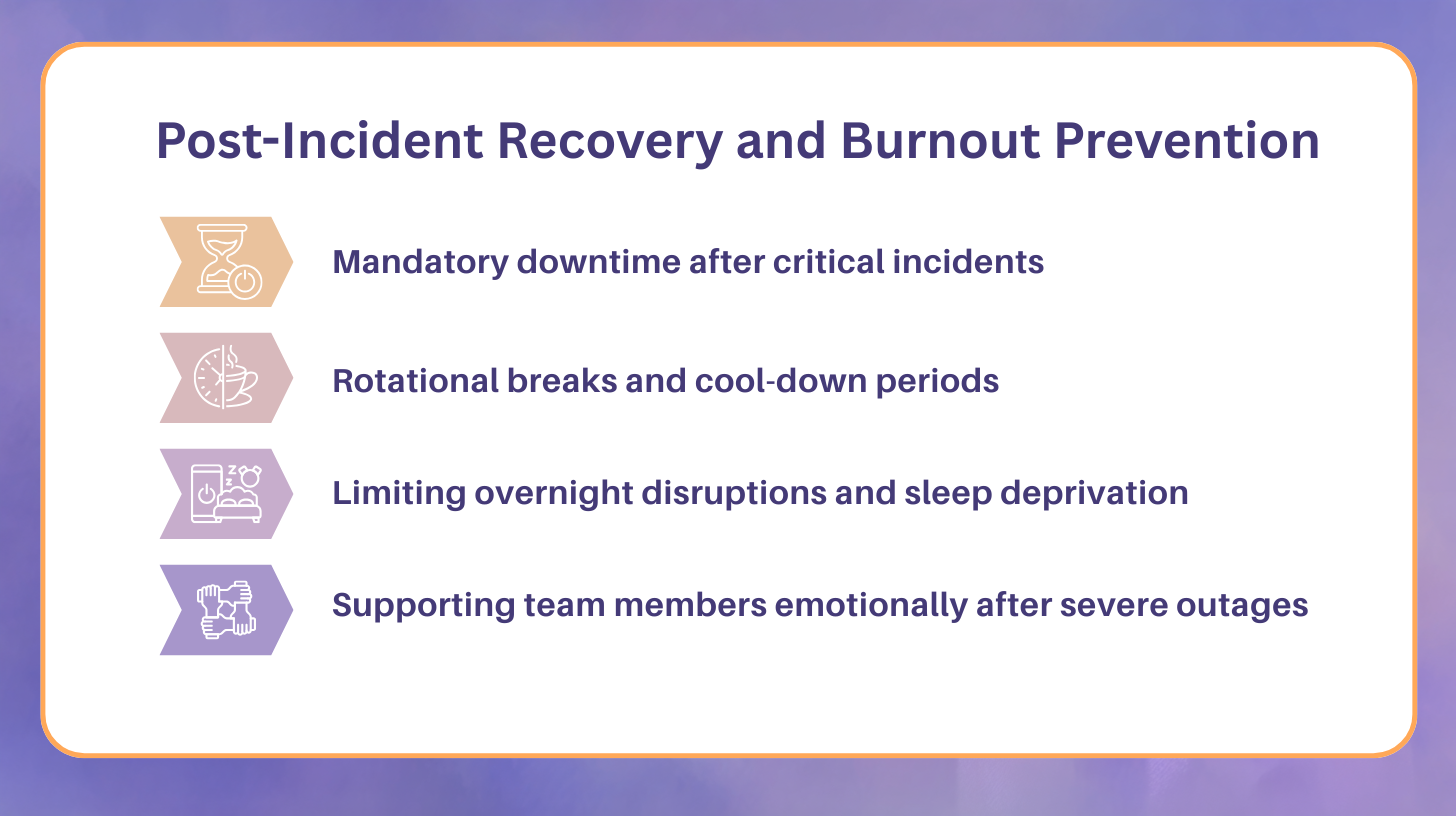
Mandatory downtime after critical incidents
People need decompression after emotionally intense outages, especially ones that disrupt sleep or require prolonged concentration. Without structured downtime, individuals may return to work mentally fogged and unable to reason clearly. Instituting enforced rest signals that recovery is not optional, it is required maintenance.
Rotational breaks and cool-down periods
Scheduling intentional breathing periods allows the nervous system to recalibrate after stress. Even short windows of complete disengagement can restore clarity and emotional balance. These pauses prevent a cumulative stress buildup that slowly erodes resilience.
Limiting overnight disruptions and sleep deprivation
Sleep is biological infrastructure, not a luxury. Humans cannot perform thoughtfully if they are awoken repeatedly or exist in a state of partial exhaustion. Reducing overnight escalation ensures that well-rested engineers make safer, faster decisions.
Supporting team members emotionally after severe outages
Sometimes the hardest part of an incident is the aftermath, when the adrenaline fades and self-doubt sets in. Offering empathetic conversations or check-ins helps engineers process the experience. Emotional support ensures the person feels valued beyond just their output.
Listening to the Team: Feedback Loops That Actually Work
- Regular rotational check-ins: Check-ins should be intimate and honest, not bureaucratic.
- Private vs public feedback: Some truths require a quiet room, while others benefit from transparent dialogue.
- Conducting on-call retrospectives: These should focus on systemic learning rather than individual blame.
- Acting on feedback instead of just collecting it: Visible implementation signals respect for the input given.
- Tracking improvements driven by frontline insights: When team suggestions result in actual change, ownership and trust deepen.
Establishing On-Call Policies That Feel Fair and Transparent
- Clear expectations of readiness and availability: When expectations are written and specific, everyone knows the rules of engagement.
- Documenting compensation structure: Money conversations should never be ambiguous. Transparency protects dignity.
- Ensuring policies are written, visible, and amendable: Good policy evolves with reality.
- Communication and consensus over mandate: Policy is more durable when shaped collaboratively.
- Legal and HR alignment: Legal clarity avoids misinterpretation and demonstrates long-term institutional maturity.
Leading On-Call With Empathy and Maturity
Strong leaders treat on-call as a human-centered responsibility, designing systems where engineers feel prepared, supported, and respected. When expectations are clear, workloads fair, and support dependable, people work with confidence rather than dread. At Rootly, we have seen that on-call built with fairness and compassion restores trust and agency, and our commitment is to help teams create environments where technical excellence and human wellbeing thrive together.