











.svg)







.png)

Modern systems do not simply fail quietly. They disrupt payments, medical care, energy supply, and digital services that millions depend on every hour. A single alert might represent revenue loss, patient harm, security breach, or operational shutdown, which is why on-call work has evolved far beyond answering a pager.
Today, reliability is no longer just technical discipline, it is deeply human, contextual, high-pressure decision-making informed by industry knowledge. Each sector has its own risks and expectations, and the teams that understand those nuances respond faster, recover smarter, and prevent future incidents more effectively.
Key Takeaways
- Fintech on-call management focuses on transactional integrity, ensuring every alert is evaluated in terms of financial impact and fraud risk.
- Healthcare on-call response prioritizes patient safety, where recovery times are measured by clinical continuity rather than general uptime.
- Critical infrastructure reliability emphasizes physical-system risk awareness, blending digital troubleshooting with operational engineering knowledge.
- SaaS reliability hinges on proactive detection, where systems should surface issues before customers experience disruption.
- Manufacturing on-call strategy integrates predictive maintenance, reducing physical downtime through sensor data and digital-twin driven diagnostics.
Core Pillars of Modern On-Call Management
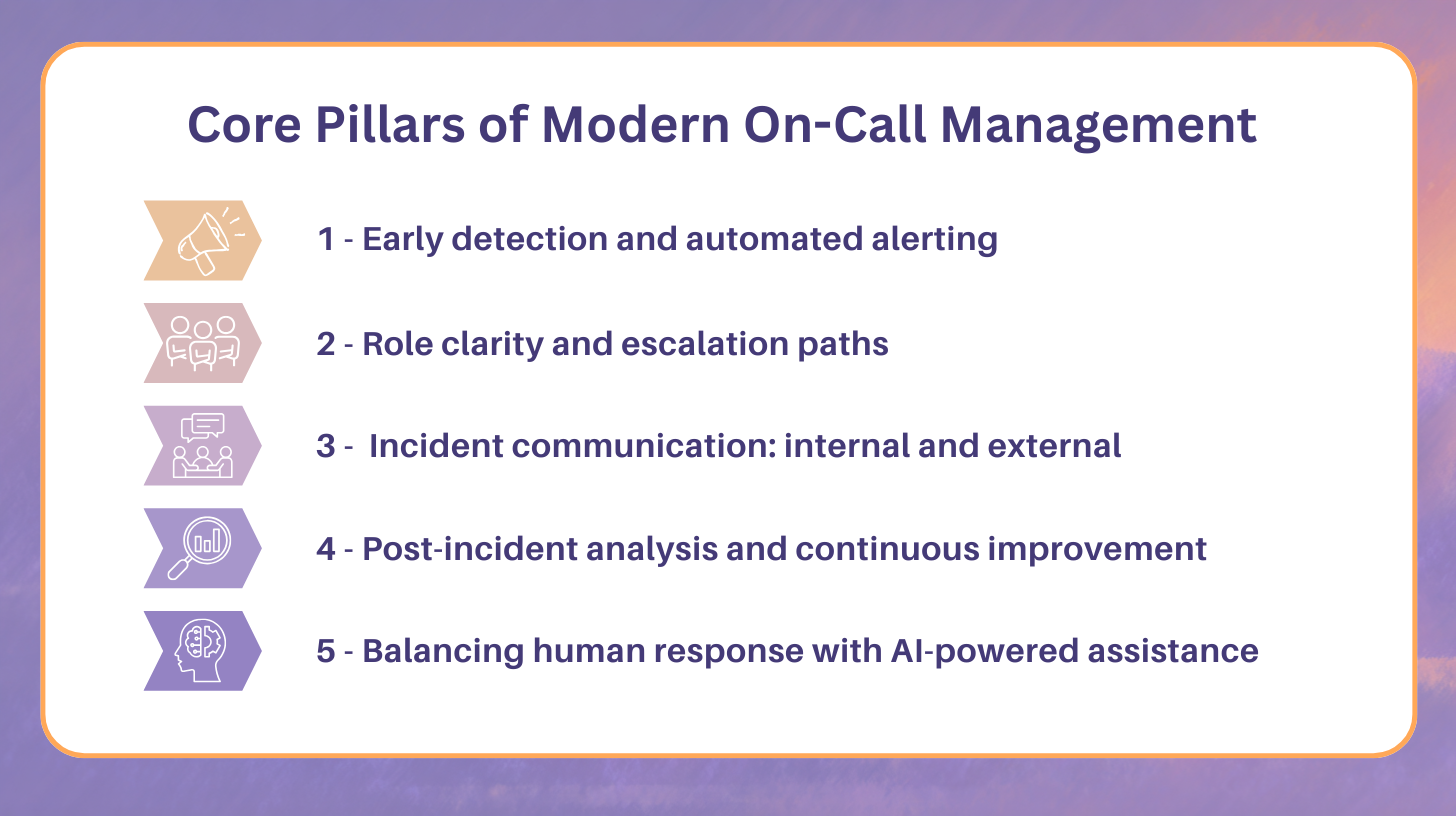
Early detection and automated alerting
Early detection begins with recognizing the baseline of normal system behavior and using that understanding as the foundation for meaningful alerts. Alerts should activate when behavioral patterns diverge from expected performance rather than waiting for catastrophic user-visible failures. Precision alerting strengthens team responsiveness by ensuring that each notification carries genuine urgency.
Role clarity and escalation paths
Clear ownership during incidents prevents hesitation and aligns accountability by establishing exactly who is responsible for solving, communicating, and escalating. Teams function more effectively when escalation authority is explicitly defined and respected. This structured clarity enables faster remediation and avoids communication paralysis during high-pressure events.
Incident communication: internal and external
Communication is a functional part of incident response rather than an administrative afterthought, because clarity directly affects reaction speed and emotional stability within the team. Internal messaging must ensure that everyone shares the same understanding of status and priorities, while external messaging shapes customer trust. How an organization communicates during disruption can influence perception long after the technical issue is resolved.
Post-incident analysis and continuous improvement
Effective retrospective analysis treats incidents as sources of organizational learning, not personal fault. Teams that investigate systemic origins rather than assigning blame uncover deeper patterns that lead to real progress. Reliability maturity grows through incremental changes that are consistently tested, applied, and refined over time.
Balancing human response with AI-powered assistance
Automation processes signals faster than humans, but it lacks the contextual judgment that human responders bring to decision-making. AI helps by classifying alerts and suggesting likely origins or potential solutions, while humans interpret these signals and weigh risk. The best reliability cultures blend the speed of automation with the discernment of human insight to maintain balanced and safe on-call operations.
On-Call in Fintech: Protecting Transactions, Security, and Customer Trust
Typical incident types in fintech
Financial services demand near-zero tolerance for errors. Typical fintech failures include:
- Transaction failures
- API outages
- Fraud detection triggers
- Real-time latency breaches
- Identity verification failures
Each of these ties directly to customer trust. People expect their money to move quickly, correctly, and securely, and when that trust is shaken, churn comes rapidly.
Compliance considerations
Fintech is heavily regulated, and incidents often trigger audit trails. Key frameworks include:
- PCI-DSS
- KYC / AML
- SOC 2 financial controls
- GDPR for EU-based customers
Compliance influences how logs are handled, how access is traced, and how communication is documented. Being unprepared for regulatory scrutiny after an incident can be more damaging than the incident itself.
Fintech on-call best practices
Fintech responders must treat every second as currency. Effective strategies include:
- Red-alert thresholds for financial impact
- Rapid rollback strategies
- Shadow release monitoring
- Incident swarming for revenue-sensitive issues
Swarming allows multiple experts to solve transactional integrity incidents simultaneously instead of sequentially. Time pressure in fintech is always financial pressure.
Fintech metrics that matter
Meaningful metrics go beyond uptime. Fintech tracks:
- MTTC
- False-positive alert reduction
- Availability for payment gateway services
- End-to-end transaction success rate
Customers care about transaction completion, not abstract uptime. Metrics should mirror customer-visible reliability.
On-Call in Healthcare: Availability, Safety, and Privacy
Typical incident types in healthcare IT
Failures in healthcare are far more than technical issues. Common problems include:
- EHR downtime
- Device communication loss
- Scheduling and patient-care system errors
- HIPAA-triggered security alerts
The consequences of a slow response can affect real patient outcomes, not just SLAs.
Life-critical implications of slow incident response
A delayed response in a hospital system might mean delayed medication orders or inaccessible patient histories. Clinical staff might revert to pen-and-paper workflows, which increases risk and reduces care efficiency. On-call responders must internalize that their work touches real lives.
Legal and compliance obligations
Healthcare is governed by strict privacy and safety rules:
- HIPAA
- HITECH
- ISO 27799
- HL7 and FHIR interoperability
These require privacy-safe handling of data during incident review and prohibit careless log exposure.
Healthcare on-call best practices
The smartest healthcare responders plan for system-level redundancy. Key approaches include:
- Redundancy for life-critical systems
- Graceful degradation and manual workflows
- Medical sensor failure protocols
- Incident communications to clinical teams
Systems must support fallbacks that keep care functioning even during outages.
Healthcare KPIs
Teams track reliability metrics that map to medical continuity:
- Time to clinical recovery
- System uptime for EHR
- Alert prioritization by patient risk level
Clinical urgency dictates escalation priority.
On-Call for Critical Infrastructure and Utilities
Typical incident scenarios
Critical infrastructure resides at the intersection of software and the physical world. Typical alerts arise from:
- SCADA system malfunction
- Network intrusion from foreign threat sources
- Electrical grid abnormalities
- Temperature or pressure threshold alarms
Response requires understanding physical-system risk alongside digital-system risk.
National-security implications
Attacks or failures in these systems can disrupt civic life, impair energy distribution, or affect national safety. The public may never hear about many incidents, but responders must treat them with strategic seriousness. Infrastructure failures ripple through society.
Compliance
Regulatory frameworks include:
- NERC-CIP
- ISA/IEC 62443
- Cyber-physical safety regulations
These frameworks emphasize cyber-physical co-protection, something unique to this industry.
On-call best practices for critical infrastructure
Reliable practices include:
- Physical-world redundancy
- Multi-disciplinary rotation combining IT and operational engineering
- Offline backup communication channels
When networks fail, responders might literally need to use radios or paper instructions.
Core metrics
Critical infrastructure measures:
- Mean Time to Physical Response
- Fault isolation time
- Environmental safety stability
Safety is the real KPI.
On-Call in SaaS and Cloud-Native Platforms
Recurring incident types
Typical SaaS incidents include:
- Multi-tenant service degradation
- Deployment-induced outages
- Dependency failures
- Third-party DNS or CDN issues
SaaS incidents cascade globally in seconds.
SaaS reliability best practices
Strong SaaS organizations invest in:
- Automated remediation
- Progressive rollout
- Synthetic traffic monitoring
- Error-budget-based alerting
SLO discipline keeps risk tolerances explicit.
Metrics for SaaS on-call
Key measures include:
- Error budget consumption
- Service availability by region
- Customer-reported vs system-detected incidents
A strong system detects failures before customers do.
On-Call in Manufacturing and Industrial Automation
Incident types
Common failures arise from:
- Robotics malfunctions
- Conveyor and equipment stoppage
- PLC firmware failures
- IoT industrial sensor misreadings
Physical downtime costs real money per minute.
Hybrid response teams: IT + operational engineers
Manufacturing demands collaboration between software and mechanical specialists. IT diagnoses system logic while engineers manage physical equipment. These worlds must meet fluidly during incidents.
Manufacturing compliance and standards
Standards include:
- OSHA
- ISO 9001
- ISO 27001
These govern both safety and data-integrity aspects.
Best practices
Optimized manufacturing reliability uses:
- Smart predictive maintenance
- Digital twins for fault diagnosis
- Wearables and worker alerting
Digital twins let responders test fixes virtually before applying them to physical machinery.
Frameworks and Models for Industry-Tailored On-Call
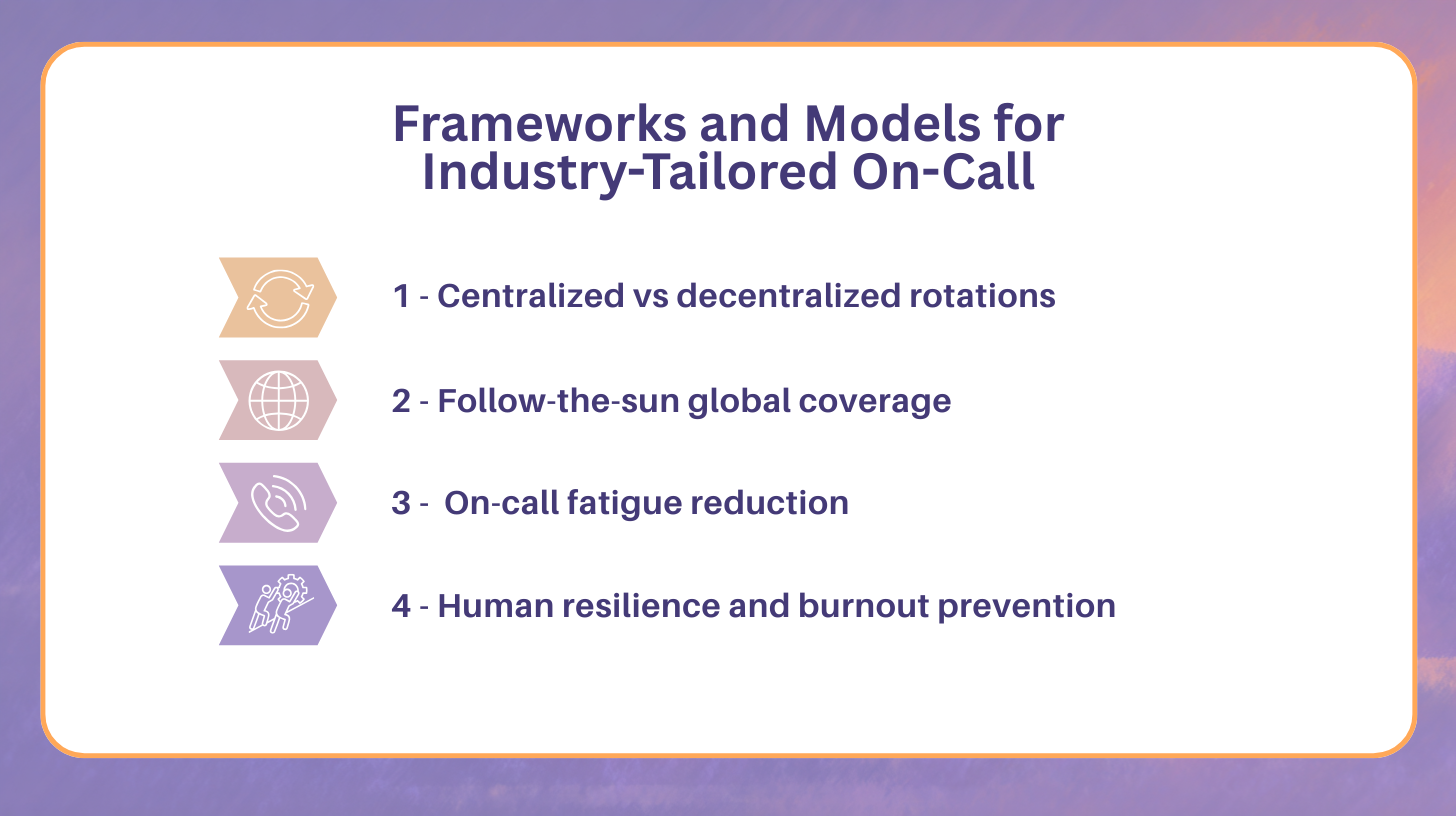
Centralized vs decentralized rotations
Centralized models offer consistency, while decentralized models offer speed and specialization. The right model depends on risk profile. Organizations often evolve toward hybrid rotations.
Follow-the-sun global coverage
Global coverage prevents night-time overload and reduces fatigue. International response rotations leverage circadian advantages. Natural time alignment creates healthier teams and faster outcomes.
On-call fatigue reduction
Systemic fatigue emerges when pages never stop. Rotations should incorporate predictable rest, page-filtering, and fair load distribution. A healthy responder is a sharper responder.
Human resilience and burnout prevention
Reliability work often involves cognitive stress and emotional weight. Mentorship, rotation fairness, and psychological safety are essential. Teams must feel valued beyond crisis times.
Incident Communication Protocols
- Internal stakeholder communication ensures that engineers, management, and support teams receive aligned information and understand the incident status as it evolves.
- Customer-facing status pages provide transparent, confidence-preserving updates that communicate impact without revealing sensitive technical details.
- Legal and compliance-driven notifications ensure that mandated reporting obligations to regulators or auditors are fulfilled accurately and on time.
- Crisis PR strategy maintains brand reputation by controlling messaging, framing accountability correctly, and preventing misinformation from spreading.
Training and Career Development in On-Call Roles
- Cross-industry incident simulation drills expose team members to a variety of realistic failure scenarios, building intuition and response confidence.
- Runbook evolution and knowledge systems create stronger incident recall by continually refining documented procedures into practical guidance.
- Mentorship, shadowing, and skill-ladder growth help newer engineers build competency while preventing knowledge bottlenecks in senior staff.
The Business Impact of High-Maturity On-Call Programs
- Reduced downtime cost directly increases revenue retention and operational continuity by minimizing disruption windows.
- Customer trust retention preserves loyalty and decreases churn by showing that reliability is taken seriously and issues are handled quickly.
- Operational resilience strengthens the organization’s ability to withstand failures with minimal impact on users, performance, or service availability.
- Regulatory risk avoidance prevents penalties and audit complications by ensuring compliance obligations are met even during critical incidents.
Building Industry-Specific Reliability That Scales
True reliability does not come from tooling alone, it comes from teams who understand the stakes of their industry and respond with clarity, discipline, and empathy. What separates average on-call programs from elite ones is the choice to learn deeply from incidents instead of fearing them. Our role at Rootly is to help organizations build that maturity, support teams during high-pressure moments, and enable reliability cultures that protect users, customers, and entire infrastructures.