

.avif)


.png)


.png)


















On-call was never meant to be a rite of suffering. Modern systems are too complex, customers demand too much uptime, and engineers are too valuable for their evenings to be fragmented by unpredictable interruptions. The shift toward automation is not merely a technical upgrade but a redefinition of what it means to maintain reliable systems without sacrificing the well-being of the people who run them. This evolution is happening quietly inside the most mature engineering organizations, and it is rapidly transforming on-call from a reactive burden into a scalable operational advantage.
Key Takeaways
- Automated on-call reduces burnout by cutting unnecessary alerts and shielding engineers from constant interruption.
- Smart incident routing improves accuracy so the right responder gets the right alert based on service context and historical data.
- Faster MTTR through automation directly increases uptime, SLA confidence, and customer satisfaction.
- Shared knowledge and runbooks strengthen reliability by transforming individual memory into accessible organizational insight.
- Proactive detection and AI-assisted troubleshooting turn on-call from reactive firefighting into preventative operational stability.
Why On-Call Is Broken Today
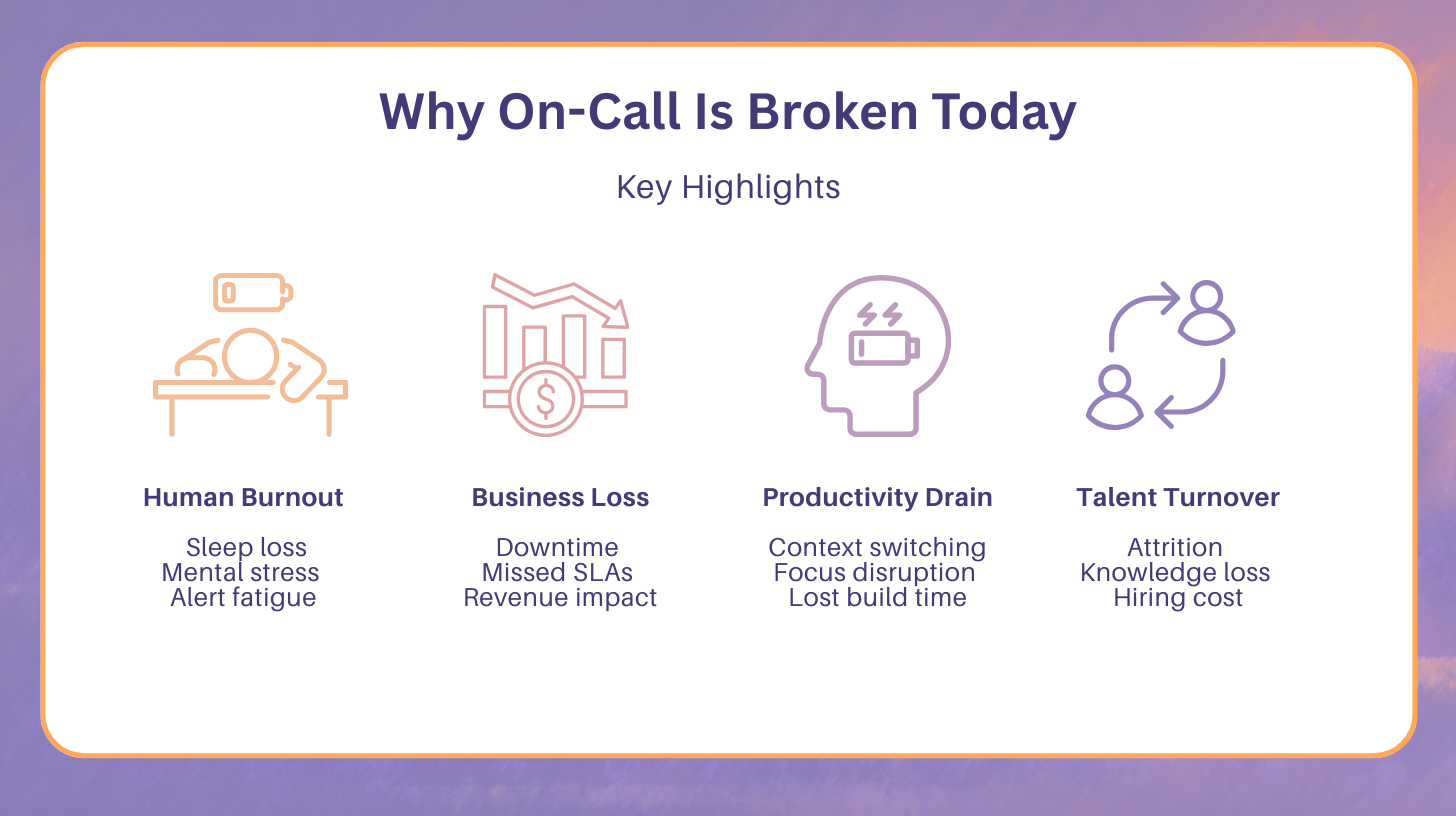
The Real Human Cost: Burnout, Sleep Disruption, and Alert Fatigue
Anyone who has ever been paged at 2AM knows that the emotional toll accumulates slowly until it becomes structural exhaustion. Disrupted sleep cycles impair cognition the following day, and accumulated stress weakens morale and increases cynicism in the job. Engineers often internalize the fear of unpredictability, learning not to relax even during off hours because a page could arrive at any moment. Eventually, this leads to disengagement and burnout that feels inevitable rather than preventable.
The Organizational Cost: Downtime, Missed SLAs, Lost Revenue
The financial impact of outages often exceeds internal awareness. A single hour of service interruption can cost large organizations millions, not only in direct revenue but in reputational damage and lost customer trust. Missed SLAs result in penalties and contractual breaches, and silent churn emerges as customers quietly move to competitors. This is where the hidden cost of reliability shows up, not only in technical metrics but in business outcomes.
The Productivity Cost: Context Switching and Recovery Time
When an engineer is interrupted mid-flow, they lose much more than the moment of disruption. Returning to the original mentally demanding task often requires a decompression period before cognitive focus can resume. This cycle of interruption and recovery means hours of productive engineering time vanish each week. The irony is that engineers are hired to build, but manual on-call forces them to react rather than create.
The Turnover Cost: Hiring, Training, and Ramp-Up Burden
Every engineer lost due to burnout must be replaced at hiring, onboarding, and training expense. Ramp-up time is unavoidable, and system familiarity is not easily transferred. The institutional knowledge lost through attrition often surpasses the visible recruiting cost. Companies underestimate this until the senior engineers leave and suddenly the operational safety net disappears.
Manual On-Call vs Automated On-Call
| Aspect | Manual On-Call | Automated On-Call |
|---|---|---|
|
Alert Routing |
Randomized or tribal knowledge | Intelligent matching to the right responder |
|
Escalation |
Human-triggered | Policy-based and automatic |
| Context & Logs | Scattered across tools | Centralized in one view |
| Incident Rooms | Ad-hoc | Auto-created with correct stakeholders |
| Reporting | Manual write-ups | Auto-generated postmortems |
| Fatigue | High | Dramatically lower |
| Cost | Increasing over time | Decreasing as automation scales |
Reactive vs Proactive Incident Response
Manual on-call is inherently reactive, engaging engineers only after things break. The proactive model leverages automation to detect patterns early and addresses issues before customer impact. Proactive systems reduce not only resolution time but also the frequency of incidents. This shift creates breathing room where engineering can focus on prevention rather than emergency response.
Interrupt-Driven Work vs Focus-Driven Work
Work shaped by random interruptions is fundamentally different from work shaped by intentional time allocation. Automated on-call funnels attention to the right people at the right times, minimizing unnecessary disruption. Instead of anyone being paged for anything, incidents flow to the contextually appropriate responder. The difference in mental clarity becomes profound.
Schedule Chaos vs Intelligent Scheduling Systems
Manual scheduling is fragile and dependent on memory, spreadsheets, or goodwill. Intelligent scheduling systems understand rotations, shifts, time zones, and overrides. Swaps become trivial, and emergencies do not derail coverage. Instead of scheduling being a political negotiation, it becomes an automated service.
Tribal Knowledge vs Shared Knowledge Base
Tribal knowledge is fragile because it exists inside individuals. Shared knowledge systems are resilient because they exist inside the collective organization. Automation pushes documentation into the operational workflow, so answers are available the moment they’re needed. Knowledge becomes a permanent asset rather than a temporary memory.
What On-Call Automation Actually Means Beyond Just Alerts
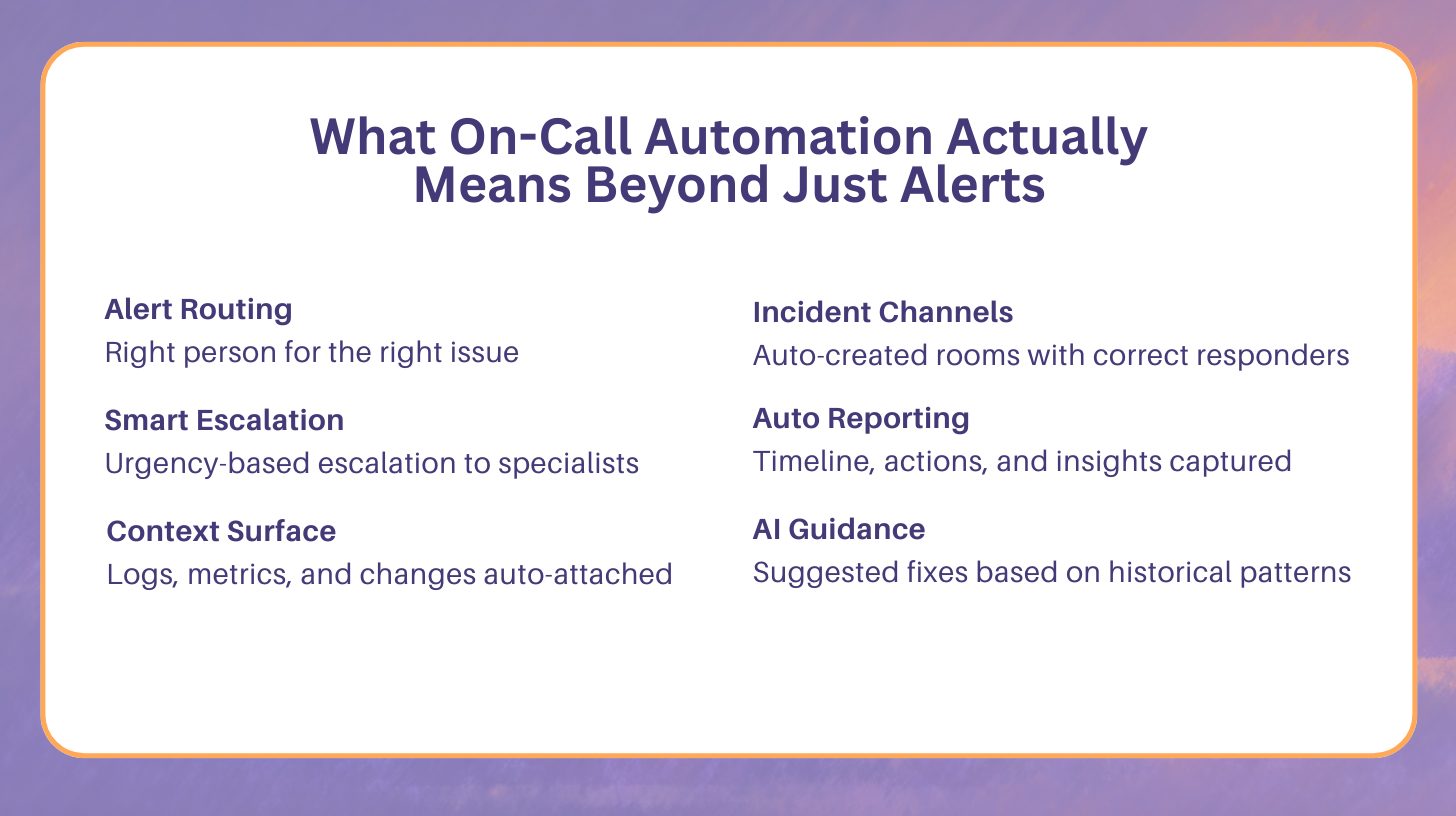
Automated Alert Routing and Team Matching
Routing incidents by keyword, severity, source, or service improves accuracy. Systems learn over time through historical resolution data, refining the match between alert and responder. This boosts efficiency and dramatically lowers mis-paging.
Intelligent Escalation and Paging Policies
An intelligent escalation system understands urgency and prioritizes response pathways. Instead of paging individuals sequentially, it can escalate directly to second-level specialists when needed. The system handles the coordination work that humans usually fumble under stress.
Incident Context Enrichment
When an incident occurs, enriched context is the difference between guessing and knowing. Surfacing logs, metrics, commit diffs, change histories, and ownership maps allows for targeted investigation rather than blind troubleshooting. This is where minutes become seconds and hours become minutes.
Automated Incident Rooms and Communication Channels
Systems that auto-create the incident channel and pull in the right responders eliminate informational friction. Communication flows immediately rather than requiring coordination. This enables collaboration without administrative overhead.
Automated Post-Incident Reports and Tickets
Rather than engineers spending an hour reconstructing timelines, automation extracts timestamps, actions, and messages. Reports become precise, objective, and consistent. Human effort is reserved for insight rather than transcription.
AI-Based Suggestions and Remediation Assistance
AI can recognize patterns across historic incidents and recommend specific remediation steps. These suggestions resemble having a silent advisor in the room who remembers every similar incident that ever occurred. It shifts response from intuition to informed action.
Follow-the-Sun Scheduling: Eliminating 3AM Pages
Global Coverage vs Local Coverage
Local coverage forces people into night duty and sleep fragmentation. Global coverage enables handoffs between awake teams where responses come from rested engineers. Teams become globally distributed not for cost reasons but for humane support.
Reducing MTTR with Awake Responders
Awake responders reason more clearly and troubleshoot more effectively. Instead of a sleepy engineer searching for clarity, a daytime colleague proceeds with confidence. MTTR naturally decreases because cognitive sharpness is preserved.
How Rotation Models Impact Mental Health & Performance
Healthy scheduling fosters trust and fosters a sense of sustainable career longevity. Engineers regain the ability to fully disconnect during off hours because coverage is continuous. The psychological safety gained here is invisible but transformative.
The Economics of Automating On-Call
Cost of False Alerts and Over-Paging
Every unnecessary alert is an invisible tax on the workforce. Over-paging erodes confidence in the alerting system, causing engineers to mentally tune out alarms. The result is slower real-incident recognition due to alarm desensitization.
Cost of Downtime and SLA Breaches
Downtime costs scale with minutes, not hours. Faster response directly correlates to lower financial losses. Automation shrinks the response window and decreases the duration of negative customer impact.
Cost of Engineer Fatigue and Burnout
Burnout often precedes resignation. The cognitive load of unpredictable interruptions deteriorates resilience over time. This cost appears in disengagement long before resignation letters are written.
Cost of Hiring and Attrition Due to On-Call Stress
Replacing a senior engineer can cost multiples of their salary. Organizational memory is expensive to rebuild. Preventing attrition is economically smarter than continuously replacing talent.
Cost of Manual Documentation and Reporting
Manual reporting drains time from deep engineering work. Automation frees engineers to contribute at their highest skill level rather than serving as witnesses to incident history.
Cost Comparison Table: Manual vs Automated On-Call
| Cost Factor | Manual | Automated |
|---|---|---|
|
Downtime |
High | Reduced |
|
Burnout |
Very high | Low |
| Hiring due to attrition | Increasing | Stabilizing |
| Report generation time | Hours | Seconds |
| Alert confidence | Low | High |
| MTTR | Long | Shrinking steadily |
Measuring ROI of On-Call Automation
MTTR Improvement
Lower MTTR is one of the most measurable outcomes. Faster resolution means higher availability and fewer angry customers. It creates measurable financial benefit over time.
MTTD Reduction
Automated alerting identifies anomalies earlier than humans ever could. This early detection avoids snowballing failures and protects system stability. The result is fewer large-scale incidents.
Percentage of Alerts Auto-Resolved
This is the silver bullet metric. When the system can fix known problems automatically, engineers are shielded from repetitive noise. It feels like lifting weight off a collective mind.
Reduction in Human-Triggered Escalations
Escalations guided by policy rather than emotional urgency create calmer resolution environments. Engineers no longer feel like they must manually hunt for help. The system does the coordination.
How AI Changes On-Call
- AI-Generated Root Cause Hypotheses identifies likely causes by correlating system signals and logs, allowing engineers to focus deeply instead of exploring blindly.
- AI-Suggested Troubleshooting Paths provides targeted remediation steps based on historical fixes so responders act with guided certainty.
- Automated Runbook Execution enables predefined remediation steps to run autonomously, saving engineer time while keeping oversight and control.
- LLM-Generated Postmortems turns raw incident data into clear human-readable narratives that eliminate manual reconstruction efforts.
- Predictive Incident Prevention anticipates emerging system failures before impact, turning on-call from reactive response into proactive stability.
Runbooks, Playbooks, and Institutional Memory
- From Tribal Knowledge to Structured Knowledge: Verbal knowledge stored in individuals transforms into shared organizational memory embedded into operational workflow.
- Automating Common Fixes: Frequent resolutions evolve into repeatable scripts while rare fixes remain discoverable as documented insights.
- Auto-Attaching Relevant Docs at Alert Time: When an alert fires, the system immediately provides the most relevant documentation so responders act with clarity.
- Product vs Infrastructure vs Network Runbooks: Different runbook classes allow deep specialization while still supporting unified and cohesive operational practices.
Cultural Transformation: On-Call as a Shared Responsibility
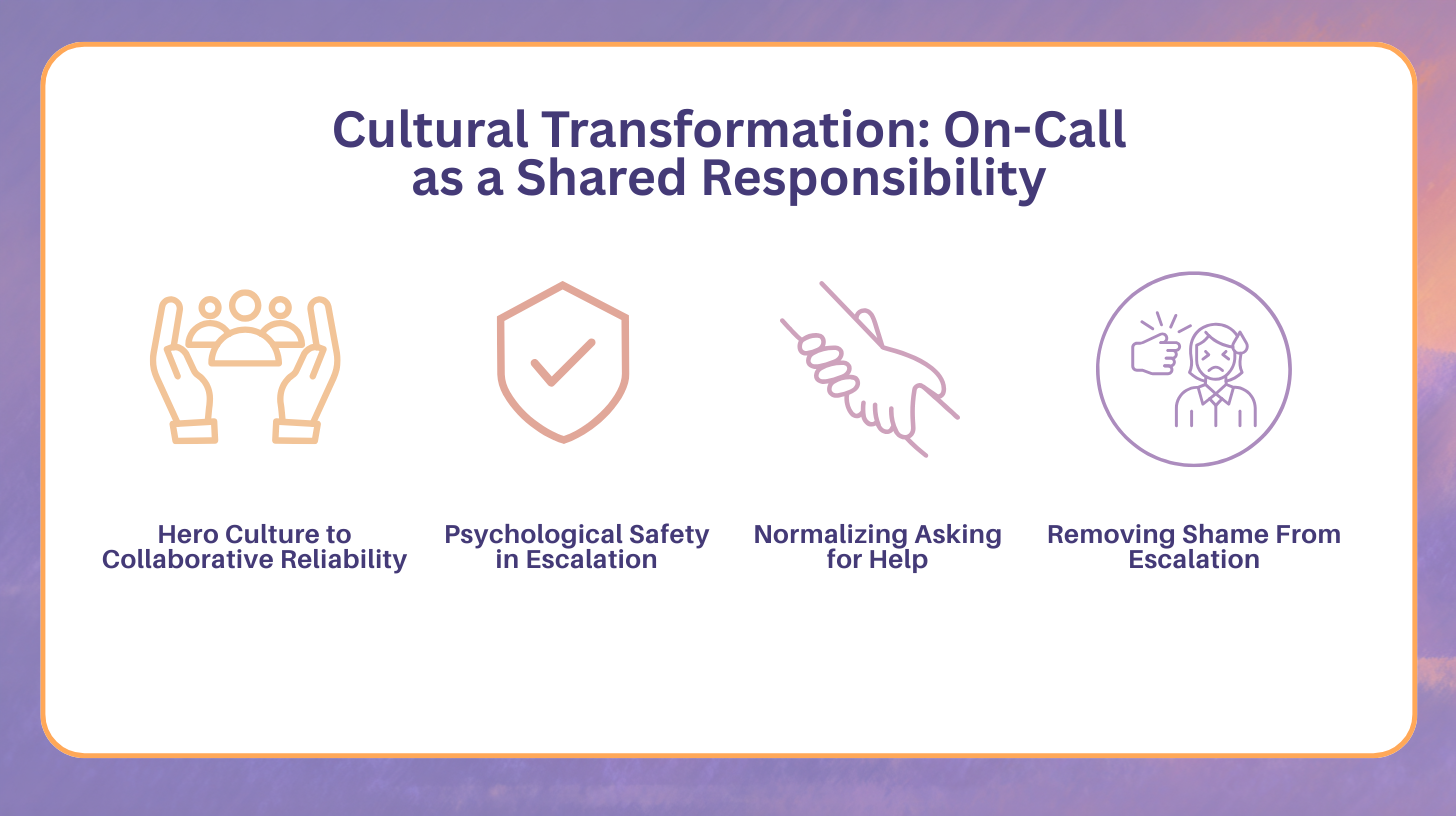
From Hero Culture to Collaborative Reliability
Hero culture glorifies the firefighter personality who rushes in and saves the day, but it ignores the quiet stability created by proactive prevention. Mature organizations shift recognition toward those who design resilient systems and reduce the likelihood of incidents in the first place. This transition creates a healthier operational culture where reliability is a shared craft rather than an individual performance.
Psychological Safety in Escalation
Engineers need to feel that asking for help is a natural part of problem solving instead of a personal failure. When escalation is treated as a procedural mechanism rather than a judgment of competence, tension evaporates and collaboration strengthens. This creates environments where engineers engage with confidence rather than hesitation.
Normalizing Asking for Help
When assistance is seen as expected rather than exceptional, people feel more connected to their team and supported in their responsibilities. Asking questions becomes an efficient pathway to resolution instead of a sign of uncertainty. Over time, this habit builds collective intelligence and accelerates learning across the entire org.
Removing Shame From Escalation
By removing emotional and cultural stigma, escalation transforms into a fluid transfer of responsibility based on expertise rather than ego. Teams respond more quickly because they are not wasting energy on internal narratives about competence or blame. The result is faster resolution and a more emotionally healthy engineering culture.
On-Call Automation Tools and Evaluation Criteria
What Good On-Call Platforms Must Support
A strong automation system includes
- Multi-layer escalation
- Real-time context gathering
- Chat-based coordination
- Shift and timeline normalization
- Fine-grained access control
- Integrations with logs, metrics, and observability tools
Avoiding Tool Sprawl and Cognitive Overload
When an organization accumulates too many tools, engineers become overwhelmed by fragmented workflows and scattered visibility. Teams perform best when the operational stack is intentionally curated rather than organically accumulated. A unified system reduces friction and mental overhead, allowing engineering effort to focus on resolving incidents rather than navigating interfaces.
How to Evaluate Vendors and Platforms
Evaluating a vendor must move beyond checking whether a product has certain capabilities and instead measure whether those capabilities materially improve uptime and operational confidence. The platform should feel like an acceleration layer rather than a learning burden. As the organization scales, the system must grow with it, adapting to increasing service complexity while remaining easy to use.
Building the Business Case
- Speak in Dollars, Not Feelings Executives respond to financial framing where reduced downtime directly translates into revenue protection.
- Tie Automation Directly to Uptime and SLA Confidence When error budgets contract, leadership understands reliability as a measurable competitive strength.
- Highlight Employee Retention and Happiness Metrics Happier engineers produce stronger teams and reduce the significant cost of losing and replacing talent.
- Frame Automation as Competitive Advantage Fast and calm incident response becomes a market differentiator where reliability is visible to customers and partners.
Real-World Before-and-After Scenarios
Manual On-Call to Automated On-Call Example
Manual incident handling often resembles frantic improvisation where responders must piece together context across multiple tools. Automated response feels more like orchestration where key data and historical patterns are surfaced instantly. The result is faster decision-making and significantly less cognitive strain during critical moments.
Human-Triggered Paging vs AI-Assisted Triaging
When paging is manual, engineers feel responsible for judging urgency and escalation paths, which introduces stress and uncertainty. AI-assisted triaging removes that emotional burden by routing alerts based on objective severity signals and historical outcomes. Humans stay mentally fresher because they no longer act as the incident traffic controller.
Incident Resolution Time vs System-Assisted Diagnosis
Without automation, engineers spend the majority of time searching for the cause rather than addressing it. When the system performs correlation and pattern recognition, humans can move straight into remediation mode. This shortens resolution cycles and transforms incident response from guesswork into precise execution.
Roadmap to Implementing On-Call Automation
Phase 1: Audit Alerts and Current Pain Points
The first step is understanding where the noise originates and which alerts consistently drain attention. Teams should categorize alerts into actionable, redundant, and low-value categories to identify unnecessary triggers. This process creates the visibility needed to reduce alert fatigue and build trust in the system.
Phase 2: Standardize Runbooks and Escalation Paths
Having a consistent response for known incidents ensures predictable and reliable outcomes. Standardizing runbooks also turns institutional knowledge into accessible operational memory. Once escalation pathways are structured, the organization becomes ready for automation to build upon that foundation.
Phase 3: Automate Reporting and Documentation
Automation should eliminate the manual overhead involved in compiling timelines, copying logs, and writing incident summaries. Engineers regain hours every week that were previously lost to administrative after-action tasks. Teams benefit from cleaner, more consistent post-incident records generated automatically.
Phase 4: Introduce AI-Based Recommendations
AI learns from previous incidents and begins surfacing correlations that humans might overlook. Recommendations become smarter over time, especially as the system recognizes recurring patterns and root cause signatures. The result is augmented decision-making where AI supports, rather than replaces, human judgment.
Phase 5: Optimize and Evaluate Performance Gains
Teams should measure improvements in MTTR, alert routing accuracy, incident frequency, and staff experience. As performance gains appear, automation policies can be fine-tuned to better align with operational needs. This ongoing refinement leads to a compounding improvement cycle where automation enhances both technical reliability and human resilience.
A Healthier, Faster, More Reliable Way Forward
On-call automation is not about replacing human engineers but about protecting them while improving system resilience and reliability. By moving from reactive firefighting to proactive operations, teams gain clarity, reduce burnout, and support sustainable engineering cultures. At Rootly, our goal has always been to build a world where engineers sleep more, systems break less, and incidents become opportunities for learning rather than fully awake crises.